

Nonprofit Revenue Recognition: A 3-Step Process
Updated On: 09/11/2026
Posted On: April 17, 2024
Revenue is a big deal for any organization. It’s what fuels your operations and mission. Revenue data informs decisions made by nonprofit management, board members, donors, funders, and creditors. Accuracy is paramount, which makes revenue recognition a critical element of nonprofit accounting.
Yet, it’s not a simple task. Nonprofit funding models can involve multiple revenue streams, such as individual contributions, government grants, sponsorships, membership dues, pledges, in-kind donations, and sales of goods and services. To add further complexity, donors and funders can limit how and when their contributions can be used. These restrictions must be carefully tracked and reported because nonprofits are obligated to follow them.
Accounting for nonprofit revenue requires a thorough understanding of the applicable accounting standards, careful evaluation of contracts and grant agreements, and sound professional judgment.
This guide will help you begin understanding how to evaluate revenue transactions and apply the proper accounting treatment. We explain the core process in three practical steps, highlight key concepts from the accounting guidance, offer tips and best practices, and provide real-world examples for you to check your understanding.
3 Steps for Proper Nonprofit Revenue Recognition
Whether your nonprofit’s funding model is straightforward or complex, follow this process to determine how to record your revenue transactions in accordance with GAAP.
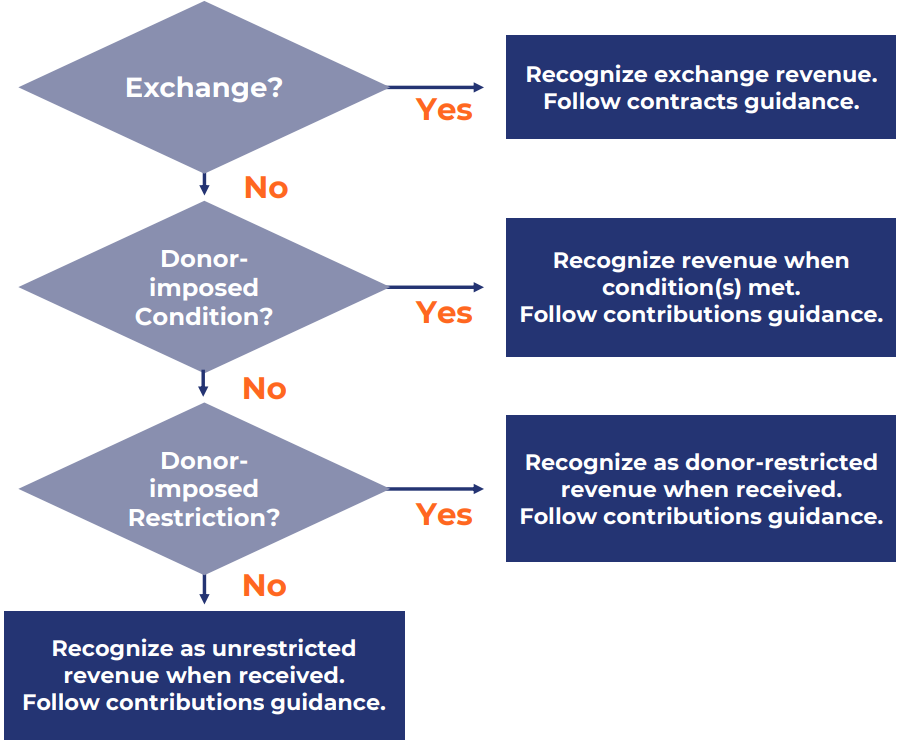
This flowchart represents YPTC’s interpretation of the process for distinguishing contributions from exchange transactions.
Step 1: Identify the Revenue Transaction Type
The first step for revenue recognition is to determine whether a transaction is an exchange (reciprocal) or a contribution (non-reciprocal).
Exchange
An exchange transaction is one in which both parties exchange resources for goods and services of direct commensurate value. In an exchange transaction, the party purchasing the goods and services might be called a “customer,” a “client,” or a “resource provider.”
Common examples of exchange transactions provided by nonprofits include:
- Sales of goods and services like tickets, merchandise, and consulting services
- Program service fees like tuition, early childhood education, housing program fees, and job placement fees
Contribution
In contrast, a contribution is non-reciprocal; a donor or funder is voluntarily transferring resources without receiving value directly in return. Importantly, any indirect value a contributor receives from funding public-benefit outcomes is not considered direct commensurate value for revenue recognition purposes.
Common examples of contributions received by nonprofits include:
- Financial donations like grants and gifts of cash or stock
- Nonfinancial donations (also known as in-kind donations) like gifts of goods, services, or property
- Promises to give (pledges) financial or nonfinancial donations
The following factors can help you distinguish between contributions and exchange transactions:
While this determination may seem straightforward, sometimes a revenue transaction, such as membership dues or a special event, can have both exchange and contribution components. These transactions must be separated and accounted for based on their components. Use the applicable revenue guidance to determine the amount attributable to the goods and services provided (the exchange). Then, account for the resources received in excess of the exchange amount as a contribution.
Guidance and Next Steps
For transactions, or parts of transactions, that are exchanges, apply the guidance in FASB ASC Topic 606, Revenue from Contracts with Customers. Under ASC 606, revenues from exchange transactions are typically recognized as the goods or services are provided. Thus, recognition might occur at a point in time (e.g., when a ticketed performance occurs) or over a period of time (e.g., as consulting services are provided).
Applying ASC 606 requires a five-step process:
- Identify the contract with a customer (enforceable rights and obligations exist for both parties and collectability is likely).
- Identify the performance obligations (goods or services promised in the contract).
- Establish the transaction price (consideration the nonprofit is entitled to receive in exchange for providing the promised goods or services).
- Allocate the transaction price to each performance obligation.
- Recognize revenue as performance obligations are satisfied.
When payment from a customer in an exchange transaction is received before goods or services are delivered, record the receipt as deferred revenue (a liability).
For transactions, or parts of transactions, that are contributions, apply the guidance in FASB ASC Subtopic 958-605, Not-for-Profit Entities: Revenue Recognition – Contributions. This requires continuing on with the steps that follow.
Step 2: Evaluate Donor-Imposed Conditions
Once you have identified a contribution, the next step is to determine whether it is conditional or unconditional. This affects the timing of revenue recognition.
Conditional
A conditional contribution or pledge includes an objective and measurable performance barrier that must be met before the nonprofit is entitled to the donation given or promised. You might think of a barrier as “strings attached,” something your nonprofit has to do or accomplish related to the purpose of the award in order to receive the funding.
Examples of barriers include requirements to incur qualified expenses, hire specific individuals, expand facilities, raise (match) a specific amount of funds, achieve a specified level of service or output, or provide a research report that summarizes findings from a grant-funded study. Administrative requirements (e.g., to maintain tax-exempt status or submit routine reports), “best effort” metrics, and standard termination clauses generally are not barriers because these stipulations are not directly related to the purpose of the award.
In addition to the existence of a barrier, the donor must have a right of return or release of its obligation to provide the funds if the barrier is not met for the contribution to be conditional. The right of return or release must be linked to not achieving the barrier. This means a grant can include a right of return (e.g., return of unspent funds) and not be conditional. An example from ASC 958-605 illustrates this point:
A nonprofit receives a foundation grant to support its capital campaign for constructing a new building. The grant agreement contains a right of return of any funds that aren’t used for the new building construction. It does not include any specifications on how the building should be constructed. The nonprofit concludes that the grant is unconditional because the foundation only limited what project the funds are to be used for (a purpose restriction – see step 3); it did not stipulate how the work should be performed. The nonprofit records the full amount of the grant upon receipt as donor-restricted revenue.
Unconditional
In contrast, if there are no donor-imposed conditions—that is, if a contribution has neither a measurable performance barrier nor a right of return or release, or it has one but not the other—then it is unconditional.
Guidance and Next Steps
Donor-imposed conditions affect the timing of revenue recognition:
- Conditional contributions are not recognized until the donor-imposed conditions are met. When conditional contributions are received before conditions are met, record the receipt as a refundable advance (liability).
- Unconditional contributions are recognized when the contribution or pledge is received.
When you have determined that a contribution is unconditional, or the donor-imposed conditions have been met, move on to the next step and determine how to classify the revenue when you record it.
Step 3: Evaluate Donor-Imposed Restrictions
After evaluating a contribution for donor-imposed conditions and determining the timing for recognizing the revenue, it must be evaluated for donor-imposed restrictions to determine how to classify the revenue.
Revenue With Donor Restrictions
Donors may restrict the use of their contributions for a specific purpose (e.g., program) or time period (e.g., funding for future periods), or both. Restrictions stipulate how or when funds may be used. They are narrower in scope than the nonprofit’s mission.
Some restrictions are temporary in nature, such as a stipulation that the contributed resources be used for a particular program or after a specific date. Other restrictions are perpetual, requiring contributed resources to be maintained in perpetuity (e.g., endowments).
Restrictions are different from conditions, which are barriers to entitlement. Contributions can be both conditional and restricted. Nonprofits have a fiduciary obligation to ensure any donor-imposed restrictions are followed.
Revenue Without Donor Restrictions
Nonprofits often receive contributions that can be used at their discretion—that is, at any time, and for any purpose. These funds may be used for general operations, or for a specific program or initiative. They may be spent right away, held for a short time, or invested and held long-term depending on the organization’s needs and strategy. Examples of revenue without donor restrictions generally include donations to an annual fund, operating grants, and donations made on a nonprofit’s website.
Keep in mind, donor-imposed restrictions can be explicitly stated—the donor might state the purpose in an accompanying note—or implied by the circumstances. For example, a donor might respond to a nonprofit’s fundraising appeal to raise funds for a new playground, which would imply a donor-imposed restriction that their contribution be used for the playground. This means nonprofits should pay careful attention to how donor solicitations are worded and take care to read documentation such as grant agreements and letters or memos that accompany individual donations carefully to determine the presence or absence of donor restrictions.
Pro Tip: Regardless of the transaction type, it’s essential to maintain thorough documentation, including agreements, correspondence, and records of how funds are used. This documentation will support your revenue recognition decisions and help you provide transparency to donors and other stakeholders.
Guidance and Next Steps
Whereas donor-imposed conditions affect the timing of revenue recognition, donor-imposed restrictions affect the classification and presentation of revenue:
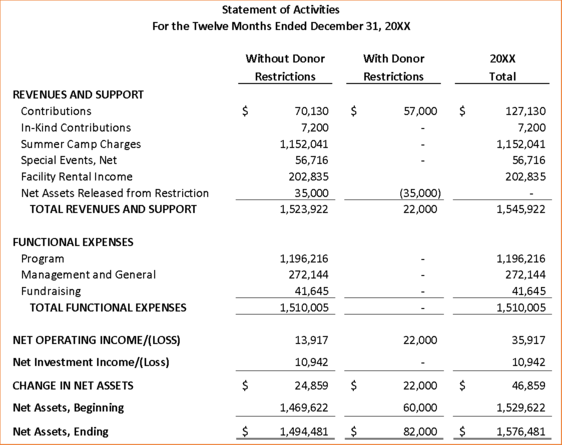
- Donor-restricted contributions are classified as “with donor restrictions” and presented on the statement of activities as increases in net assets with donor restrictions.
- Unrestricted contributions are classified as “without donor restrictions” and presented on the statement of activities as increases in net assets without donor restrictions.
Additionally, regarding presentation of revenue transactions on the statement of activities:
- Nonprofits report exchange transactions separately from contributions in the statement of activities.
- In-kind donations (gifts of nonfinancial assets) such as donated goods, services, or property, are also reported on a separate line.
- Donor-restricted funds should be reclassified from net assets with donor restrictions to net assets without donor restrictions when the donor’s stipulated purpose has been fulfilled, time frame has elapsed, or both. This reclassification is reported in the statement of activities on a separate line called “net assets released from donor restrictions.”
Here is an example statement of activities to illustrate these classification and presentation aspects:
Example: Membership Dues
To illustrate how the whole process comes together, consider this example: A nonprofit association charges its members $150 in annual dues. Members receive 12 monthly newsletters as a benefit. The fair value of the newsletters is estimated at $60. Assume no other benefits are received beyond the newsletters. How does the association recognize revenue for annual membership dues?
Step 1: Contribution or Exchange Transaction?
This transaction contains both exchange and contribution components. The member intends to receive a $60 newsletter subscription in exchange for a portion of their dues payment. The association uses the five-step process in ASC 606 to record the $60 of exchange revenue:
- The membership agreement is a contract between the association and the member that obligates both parties to perform. The association will provide the stated benefits, and the member will pay the annual dues amount.
- The association’s performance obligations are to send 12 monthly newsletters to the member.
- The amount attributed to the exchange portion of the dues payment is the estimated fair value of the newsletters: $60 ($5 per month).
- The $60 attributed to the exchange is allocated to the 12 monthly performance obligations.
- The association recognizes $5 of exchange revenue each month as issues are sent.
The association accounts for the excess of the total dues payment over the fair value of the newsletter subscription ($90) as a contribution using the remaining two steps.
Step 2: Conditional or Unconditional Contribution?
The membership agreement does not require the association to meet a barrier to be entitled to the contribution portion of the dues payment, like achieving specific performance metrics or raising matching funds. Therefore, the association determines that the $90 contribution is unconditional and recognizes the full amount upon receipt. They use the remaining step to determine how to classify the contribution revenue.
Step 3: With or Without Donor Restrictions?
The membership agreement does not specify any limitations on the use of contributed funds, so the association classifies the $90 contribution as support without donor restrictions.
Additional Resources
Understanding the nuances of nonprofit revenue recognition is critical for financial management and transparency. YPTC offers additional resources designed to help you gain a better understanding of how to apply the accounting guidance:
- Watch our related webinar for a deeper dive on accounting for revenue from contracts with customers versus contributions.
- Read our guide on revenue recognition for government grants for more focused examples and specifics that apply to grant funding.
- Learn more about donor-restricted funding and how to manage it successfully for your nonprofit.
Contact YPTC for direct, customized assistance from an experienced nonprofit accountant who can help you strengthen your financial reporting and audit readiness by:
- Evaluating grant agreements and revenue contracts
- Reviewing transactions for proper accounting treatment and correcting any errors
- Improving internal controls and processes
- Training your team on the accounting guidance that applies to your funding streams