

Demystifying the 4 Main Nonprofit Financial Statements
Updated On: 01/28/2026
Between fundraising, marketing, and keeping your programs afloat, your nonprofit team likely collects and uses a variety of financial data. This information is crucial in allocating resources effectively and fulfilling your mission.
Compiling nonprofit financial statements allows you to make sense of this data, better understand your organization’s current financial situation, develop stronger, data-backed decisions, and show stakeholders you’ve stewarded funds responsibly.
While these documents can be overwhelming to fully understand at first, we’ll break down the key concepts related to this topic, including:
- What Are Nonprofit Financial Statements?
- Why Are Nonprofit Financial Statements Important?
- Types of Nonprofit Financial Statements Explained
- How to Best Compile Your Nonprofit Financial Statements
Since for-profit organizations use similar statements to report on their activities, we’ll point out the key differences between for-profit and nonprofit financial statements along the way. Let’s get started!

What Are Nonprofit Financial Statements?
Nonprofit financial statements are documents that summarize an organization’s financial activities and health. They report information at a moment in time (as on a balance sheet) or over a specific period (as on an income statement).
These statements are not only helpful for ensuring nonprofits use their resources effectively and make informed financial decisions but also for staying accountable to stakeholders, such as donors, grantors, board members, and the general public. Plus, compiling nonprofit financial statements enables organizations to comply with Generally Accepted Accounting Principles (GAAP) and maintain tax-exempt status.
Why Are Nonprofit Financial Statements Important?
Nonprofit financial statements are a core component of GAAP guidelines and 501(c)(3) compliance. However, these reports also have other benefits, including:
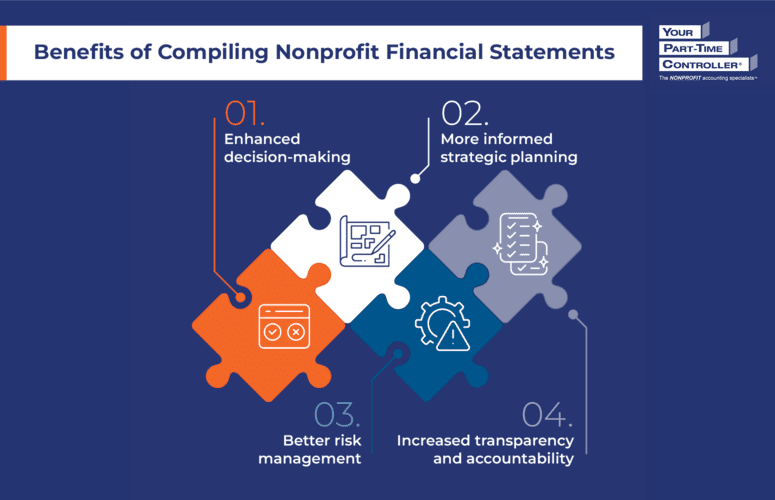
- Enhanced decision-making. With all your essential financial information in one place, you can make data-driven decisions regarding budgeting and resource allocation.
- More informed strategic planning. Similarly, nonprofit financial statements allow you to easily access the data you need to guide your strategic planning. These statements help you identify your organization’s financial strengths, weaknesses, opportunities, and risks so you can set more realistic goals and priorities.
- Better risk management. When you’re aware of potential risks that your financial statements bring to light, you can better prevent or manage them before they become larger problems.
- Increased transparency and accountability. When you share your nonprofit financial statements in your annual report, external stakeholders—such as donors, members, creditors, and the general public—receive information that allows them to determine whether your nonprofit has stewarded their contributions responsibly and assess your organization’s ability to continue providing its core services.
Nonprofit financial statements provide a snapshot of your organization’s current financial standing so you can better plan for your nonprofit’s future. With all stakeholders on the same page about your nonprofit’s finances, you can make better decisions and build trust with your community.
Types of Nonprofit Financial Statements Explained
Under GAAP, a complete set of nonprofit financial statements includes a nonprofit Statement of Financial Position, a nonprofit Statement of Activities, and a nonprofit Statement of Cash Flows. Nonprofits must also provide a functional expense analysis, and many organizations choose to meet this requirement using a nonprofit Statement of Functional Expenses. Let’s review each of these reports in more detail.
Nonprofit Statement of Financial Position
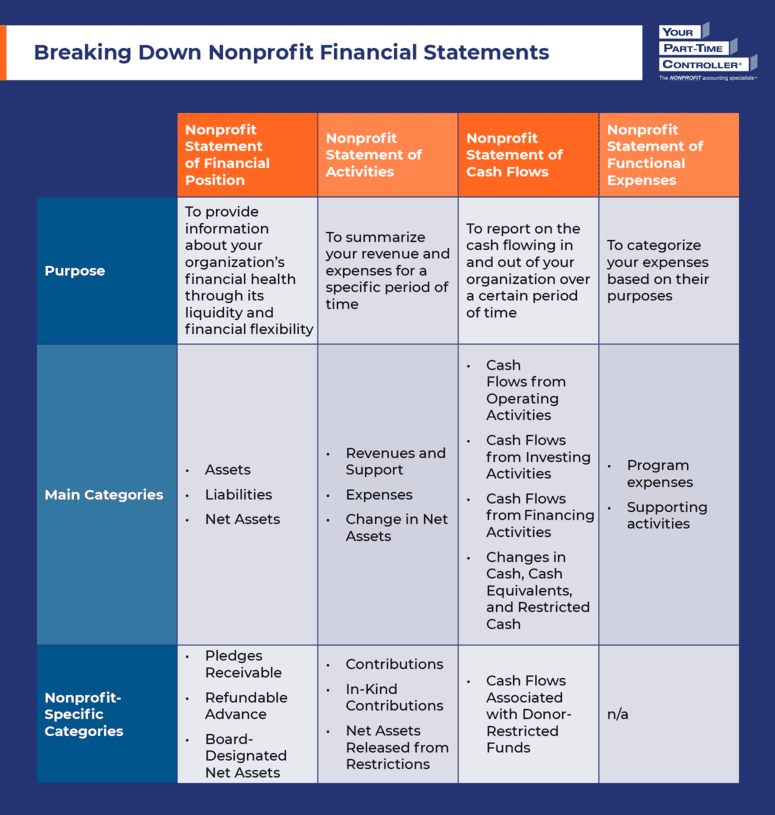
The nonprofit Statement of Financial Position, also known as a balance sheet, provides information about your organization’s financial health as of a specific date. This statement offers financial insights through your organization’s liquidity and financial flexibility, represented as assets and liabilities.
The main categories of a nonprofit Statement of Financial Position are:
- Assets. Assets are resources with economic value that your nonprofit owns or controls. You’ll list your assets in order of liquidity, or how easily you can convert them to cash. First, you’ll put current assets, which you can convert to cash quickly, such as cash and cash equivalents, accounts receivable, prepaid expenses, and inventory. Then, you’ll list noncurrent assets your organization intends to hold for at least a year, such as land, buildings, and equipment, as well as other assets such as restricted cash.
- Liabilities. These represent financial debts or obligations your nonprofit owes. You’ll typically list your liabilities in order of due date, with current or short-term liabilities, such as accounts payable, accrued expenses, and deferred revenue, first, followed by noncurrent or long-term liabilities, such as mortgages or long-term lease obligations.
- Net Assets. Subtracting your liabilities from your assets determines your net assets, or the financial resources available to your organization. This equation allows you to evaluate your nonprofit’s financial standing; positive net assets indicate a healthy financial position, whereas negative net assets may prompt you to reevaluate your resource allocation.
Additionally, this document contains line items that are unique to nonprofits, such as:
- Pledges Receivable. This line item, which falls under the assets category, represents promises from funders to donate cash or other assets in the future.
- Refundable Advance. This liability represents cash or other assets subject to donor-imposed conditions. If you don’t meet the conditions, you must return the contributed assets. For example, a donor may contribute cash to a soup kitchen under the stipulation that they serve 500 meals to low-income families. If the nonprofit does not meet this benchmark, then it must return the cash to the donor.
- Board-Designated Net Assets. These represent unrestricted net assets that a nonprofit’s board has earmarked for future programs, investments, contingencies, asset purchases, or other uses. Having board-designated net assets indicates that your nonprofit has invested in its own financial sustainability.
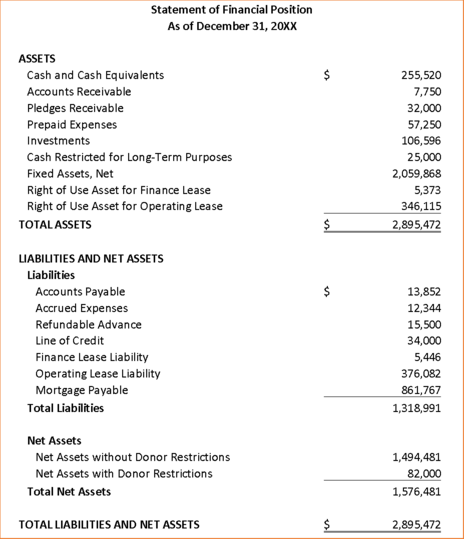
The Statement of Financial Position represents a snapshot of your assets, liabilities, and net assets at a moment in time, helping you plan for future growth based on your current resources. Check out an example of this statement below:

Nonprofit Statement of Activities
The Statement of Activities is the nonprofit version of an income statement. It summarizes your revenues and expenses for a specific period and allows both your organization and stakeholders to understand how you’re managing your resources.
The main categories of a nonprofit Statement of Activities are:
- Revenues and Support. This category represents resources or funds your organization receives. You may earn revenue from selling goods, providing services, or managing investments, while you can garner support from individual contributions, fundraising events, and grants.
- Expenses. Expenses represent costs incurred by a nonprofit to support its programming and carry out its mission. In this report, expenses are typically categorized as program, management and general, and fundraising.
- Change in Net Assets. Similar to net income in a for-profit, the change in net assets represents the difference between revenues and expenses for the period.
This document also contains line items that are unique to nonprofits, including:
- Contributions. In general, nonprofits report donor-restricted contributions or donations as restricted revenues or gains, which increase net assets with donor restrictions.
- In-Kind Contributions. Nonfinancial donations, or in-kind contributions, are a separate line item. These are goods and services that your organization would have to purchase if donors did not contribute them. Common in-kind contributions include donations of land, buildings, and supplies. They can also include the use of facilities or utilities and professional services, such as pro bono legal services.
- Net Assets Released from Restrictions. This category represents reclassifications of previously restricted net assets. Releases can occur when the donor’s stipulated time has elapsed or when the donor’s intended purpose for the funds has been fulfilled.
Additionally, your Statement of Activities must also report both the change in net assets with donor restrictions and the change in net assets without donor restrictions. Most nonprofits use a columnar approach to do so, like the example shown below:
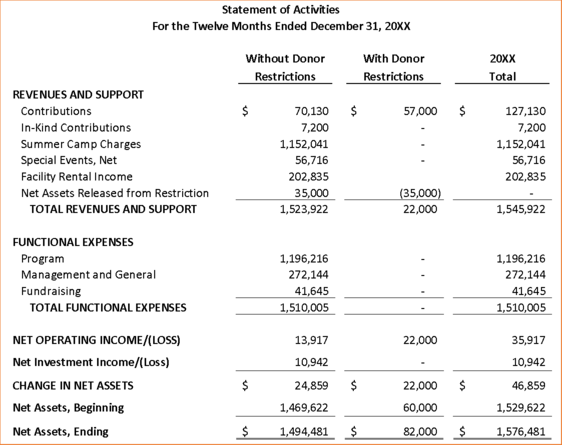
Your nonprofit Statement of Activities gives stakeholders an idea of how well you’re using funds and other resources to successfully support your programming and fulfill your mission. Compare this document to our operating budget to evaluate how well your planned revenue and expenses match your actual revenue and expenses. This exercise will help you better allocate resources for the following year.
Nonprofit Statement of Cash Flows
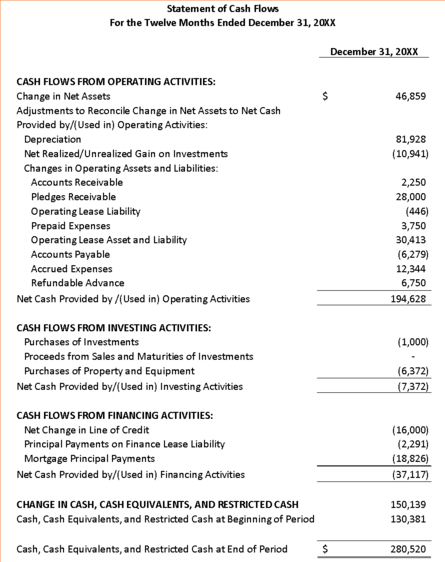
The nonprofit Statement of Cash Flows reports on the cash flowing in and out of your organization over a certain period of time. It classifies cash as stemming from either investing, financing, or operating activities, just as the for-profit version of this document would.
Therefore, the main categories included in a nonprofit Statement of Cash Flows are:
- Cash Flows from Operating Activities. Operating activities are your nonprofit’s regular, everyday functions. Cash inflows in this category may include funds from donations, program fees, grants, and membership dues, while outflows may be staff salaries and wages, utilities, supplies, and rent.
- Cash Flows from Investing Activities. Investing activities refer to how you manage your nonprofit’s long-term assets. If you’ve received any proceeds from sales or maturities of your investments, you would report those as inflows in this category. On the other hand, outflows from investing activities would be the purchases of investments themselves or property and equipment.
- Cash Flows from Financing Activities. Your financing activities relate to long-term liability management and include borrowing funds, repaying debts, and issuing or repurchasing equity. While inflows in this category may include lines of credit and proceeds from loans, outflows would be payments of any debts, such as your mortgage.
- Changes in Cash, Cash Equivalents, and Restricted Cash. At the bottom of your nonprofit Statement of Cash Flows, you’ll note your cash, cash equivalents, and restricted cash at the beginning and end of the period to assess how your cash flows—including those associated with donor-restricted funds—have changed over time.
Reporting noncash investing and financing activities requires separate disclosures. Examples of these activities may include receiving contributions of fixed assets or securities, purchasing a building by incurring a mortgage, or obtaining an asset by entering into a capital lease.
To put it simply, this document allows you to track how your nonprofit generated and used cash. You can find an example of this nonprofit financial statement below:
Nonprofit Statement of Functional Expenses
Nonprofits are required to provide an analysis of their expenses by nature and function. They can choose to do this on the face of their Statement of Activities, as a schedule in the notes attached to the full set of documents, or in a separate financial statement—the Statement of Functional Expenses. Most organizations choose the latter route.
The Statement of Functional Expenses reports expenses based on their nature and function. It allows you to remain transparent about your resource allocations to stakeholders and report expenses on your Form 990. While the full version of Form 990 is the only one that requires a complete functional expense report, Form 990-N, Form 990-EZ, and Form 990-PF all ask questions about your expenses. No matter which version you file, this document will streamline the process by gathering information in an easily accessible format.
The main categories of expenses included in a nonprofit Statement of Functional Expenses are:
- Program expenses. Any costs directly tied to your services and cause fall under program expenses. For example, a summer camp paying a bus company to transport their campers to and from camp would report this cost under program expenses.
- Supporting activities. The rest of your expenses are considered supporting activities. These fall under three main categories:
- Management and general expenses, such as costs that relate to a nonprofit’s overall operations and management.
- Fundraising expenses, such as expenses incurred in soliciting cash and noncash contributions, gifts, and grants.
- Membership development expenses, such as costs incurred in soliciting new members and membership dues, membership relations, and similar activities.
List each expense by its natural classification. These may include personnel costs, professional services, office expenses, occupancy, utilities, and depreciation.
The total expenses on the Statement of Functional Expenses should match the total expenses on your Statement of Activities. For a closer look at this statement, look at the example below:
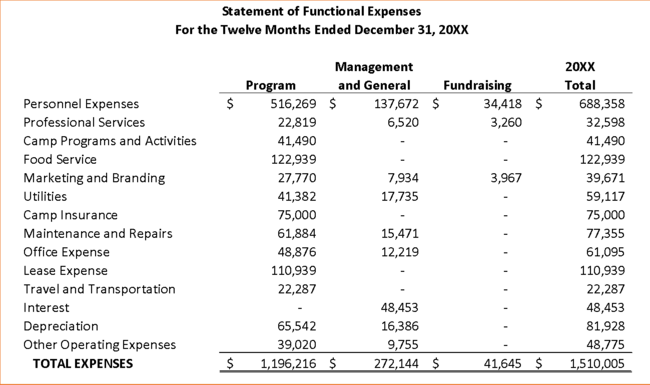
Overhead costs will fall under multiple functional categories. For example, personnel expenses may be allocated to program, management and general, and fundraising. A thoughtful, well-documented, and consistently applied overhead cost allocation strategy is an important part of sound financial management. Ensure your overhead cost allocation complies with GAAP, tax, and funder requirements and reflects true costs to provide you with helpful insights.
While historical estimates have said overhead costs should be 15 to 35% of a nonprofit’s overall expenses, newer guidance reveals that there’s no one number every nonprofit should aim for. The ideal overhead ratio for your nonprofit will depend on several factors, including your organization’s size, age, geographic location, and specific needs. Further, comparing overhead ratios among organizations can be misleading, given differing circumstances and cost allocation methodologies. Remember that while it’s helpful to review your overhead spending to see where you can streamline, you don’t want to make cuts that will prevent you from achieving your mission.

How to Best Compile Your Nonprofit Financial Statements
To create financial statements, you’ll need to prepare them within your accounting software. Unfortunately, most accounting information systems are not equipped to adequately present nonprofit accounting data.
Without a customized software solution, many nonprofits download their accounting data to Excel to compile the information in a usable format. However, this can be extremely time-consuming for your nonprofit’s team and take energy away from focusing on your mission, not to mention being more prone to human error.
That’s why YPTC is dedicated to helping organizations like yours compile and analyze their nonprofit financial statements, on top of other nonprofit accounting services. Our nonprofit expertise, flexible services, and ability to serve you from anywhere enable us to fulfill your organization’s specific accounting needs, allowing you to do what you do best: make a difference.
If you’re ready to work with experts to properly compile and analyze your financial statements, reach out to our team. In the meantime, explore these resources to learn more about nonprofit financial reports and management:
- What Is a Nonprofit Balance Sheet? Breaking Down This Report. Dive deeper into how to compile a nonprofit balance sheet or Statement of Financial Position.
- Top Nonprofit Audit Preparation Guide: What You Need to Know. Explore how to prepare for a financial statement audit.
- Nonprofit Accounting: What Charitable Orgs Need to Know. Check out this guide for a higher-level overview of nonprofit accounting concepts.


Jennifer Alleva
Jennifer Alleva is the Chief Executive Officer at Your Part-Time Controller, LLC (YPTC), a leading provider of nonprofit accounting services, #65 on Accounting Today’s list of Top 100 accounting firms and the #1 Best Firm to Work For by Accounting Today. Jennifer brings over three decades of expertise in accounting and leadership to her role as CEO of YPTC.
When Jennifer joined YPTC in 2003, the firm consisted of just over 10 staff members. Since then, she has helped grow YPTC into one of the fastest-growing accounting firms in the country.
Jennifer’s accomplishments include her tenure as an adjunct professor at the University of Pennsylvania Fels Institute, her frequent speaking engagements on nonprofit financial management issues, her role as the founder of the Women in Nonprofit Leadership Conference in Philadelphia, and her launch of the Mission Business Podcast in 2021, which spotlights professionals and narratives from the nonprofit sector.