

Nonprofit Treasurer Duties: A Practical Guide to the Role
Posted On: September 8, 2026
Nonprofit boards receive financial reports every month to help them fulfill their financial oversight responsibilities, but how well do they understand and use them? Most board members aren’t financial experts. They rely on the treasurer to explain what the reports say about the organization’s financial health and performance and interpret how that information applies to risk, strategy, and the decisions the board needs to make.
This guide explains what a nonprofit treasurer does, what qualities are important for their success, and how the treasurer fits into your organization’s financial oversight and management structure. We also answer FAQs that will help you clarify the details of this important governance role. We’ll cover:
- What is a nonprofit treasurer?
- What is a nonprofit treasurer’s purpose?
- Main Nonprofit Treasurer Duties
- How a Nonprofit Treasurer Fits Within an Organization’s Financial Oversight and Management Structure
- Qualities of a Successful Nonprofit Treasurer
- Nonprofit Treasurer Duties FAQs
- When a Nonprofit Might Need More Than a Treasurer
Key Takeaways
- A nonprofit treasurer is usually a board member who leads the board’s financial oversight responsibility.
- The treasurer should not be the organization’s bookkeeper, accountant, controller, or CFO unless the organization has clearly defined that role and protected basic internal controls.
- In smaller nonprofits, a treasurer may be more hands-on, but the board should still separate approval, custody of funds, recordkeeping, and review whenever possible.
- As a nonprofit grows, the treasurer’s role should shift toward governance: board reporting, finance committee leadership, financial policy review, audit and Form 990 oversight, and financial literacy support for the board.
- A strong treasurer helps the board see the story behind the numbers and use the financial information they receive to make decisions.

What is a nonprofit treasurer?
A nonprofit treasurer is usually a board member who leads the board’s financial oversight responsibility. They make sure the board receives timely, accurate financial information and can use it to make decisions. This includes helping board members review financial statements, monitor budget performance, understand cash-flow concerns, and ask appropriate questions about financial risks.
What is a nonprofit treasurer’s purpose?
In practice, the treasurer often serves as a bridge between management and the board. Management is responsible for day-to-day financial operations, including accounting and financial reporting. The treasurer’s role in a nonprofit is to help the board understand what management is reporting, gather additional information when the board needs more context, and ensure that policies and reporting rhythms are strong enough for effective financial oversight.
Main Nonprofit Treasurer Duties
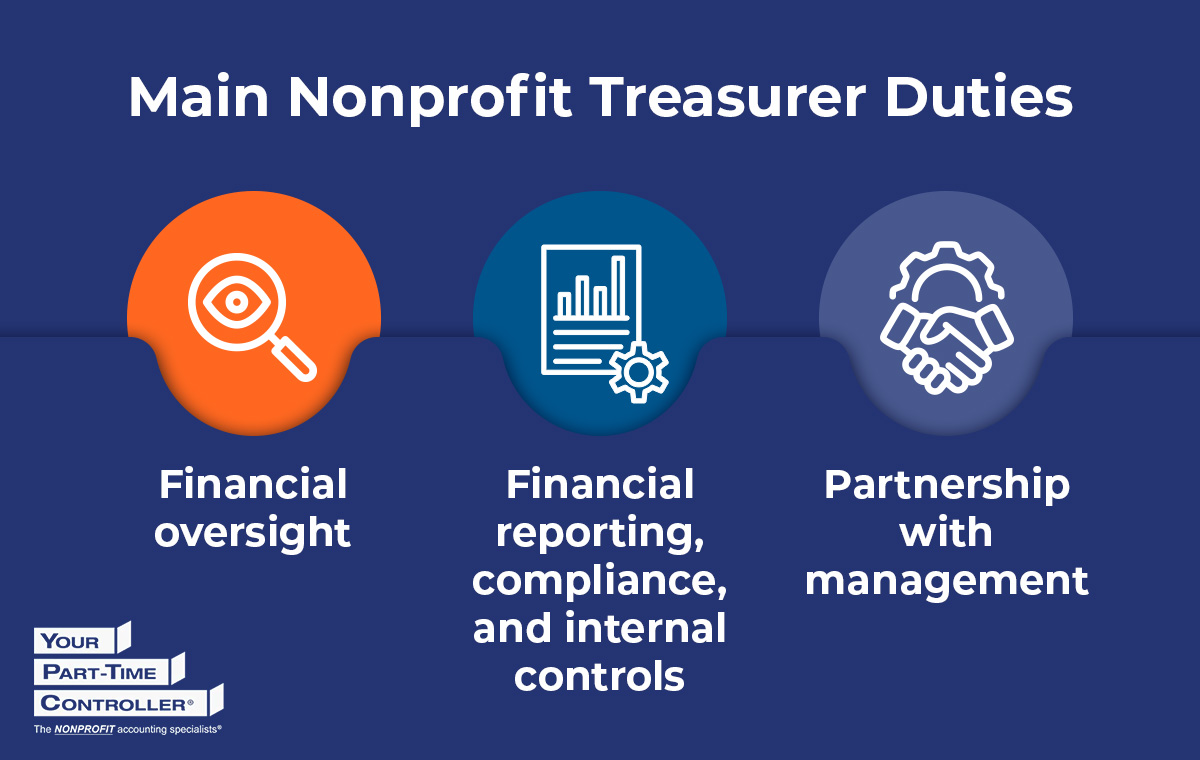
A nonprofit treasurer’s duties should be defined in the organization’s bylaws and center on one goal: strong financial oversight. While specific nonprofit treasurer responsibilities will vary by organization, the treasurer’s main duties typically include the following:
Financial oversight
A nonprofit treasurer has all the duties of a regular board member and leads the board’s financial oversight responsibility. This typically includes:
- Chairing or serving on the finance committee, if there is one
- Understanding the organization’s financial model, operations, and policies
- Actively monitoring the organization’s financial performance and overall condition
- Ensuring the full board receives timely, understandable financial information that supports strong oversight and decision-making
- Presenting financial information prepared by staff, such as the annual budget and monthly financial reports, at board meetings
- Anticipating or following up on questions the board may have about financial reporting, policies, or operations
Financial reporting, compliance, and internal controls
The treasurer and finance committee review financial information in detail and consider the organization’s plans and challenges from a financial perspective before reporting to the board. They also work to ensure the organization has strong internal controls, including financial policies that safeguard assets, prevent fraud, ensure compliance, and promote accountability.
The treasurer and finance committee monitor the finance calendar—especially audit and tax deadlines—and help ensure that all required reports and filings are submitted on time. They typically review and discuss the following items, for example, before they are presented to the full board:
- Core financial statements
- Audit reports and management letters
- Draft Form 990 reports
- Annual budget
- Budget-to-actual reports
- Cash flow forecasts
- Grant or restricted-fund reports
- Reserve balances or reports
- Financial health dashboards or key performance indicators
- Financial policies
- Major financial issues and decisions
A good treasurer can help board members build financial literacy by understanding and explaining financial information and reports, providing context, answering questions, and clarifying the mission impact of financial decisions.
Partnership with management
Ensuring the board receives clear and timely financial information and context requires close coordination with management.
The treasurer communicates regularly with the executive director, CEO, finance leader, or outsourced accounting contact. This gives management a chance to explain what’s going on behind the numbers before the board meeting and gives the treasurer time to surface any questions the full board may have.
Common discussion topics between treasurers and management include:
- Annual budget development
- Significant budget variances
- Cash-flow timing
- Restricted grant activity
- Audit preparation
- Form 990 review timing
- Reserve use or reserve policy questions
In addition, if there are operational issues with the monthly close or reporting process, such as outdated systems or insufficient accounting capacity, the treasurer works with management to better understand them. That way, they can explain to the board whether the issues are temporary or long-term, and whether additional accounting support may be needed.
How a Nonprofit Treasurer Fits Within an Organization’s Financial Oversight and Management Structure
A nonprofit’s financial oversight and management are strongest when roles are clearly defined. In a healthy structure, management, finance staff, treasurer, and board roles are typically defined as follows:
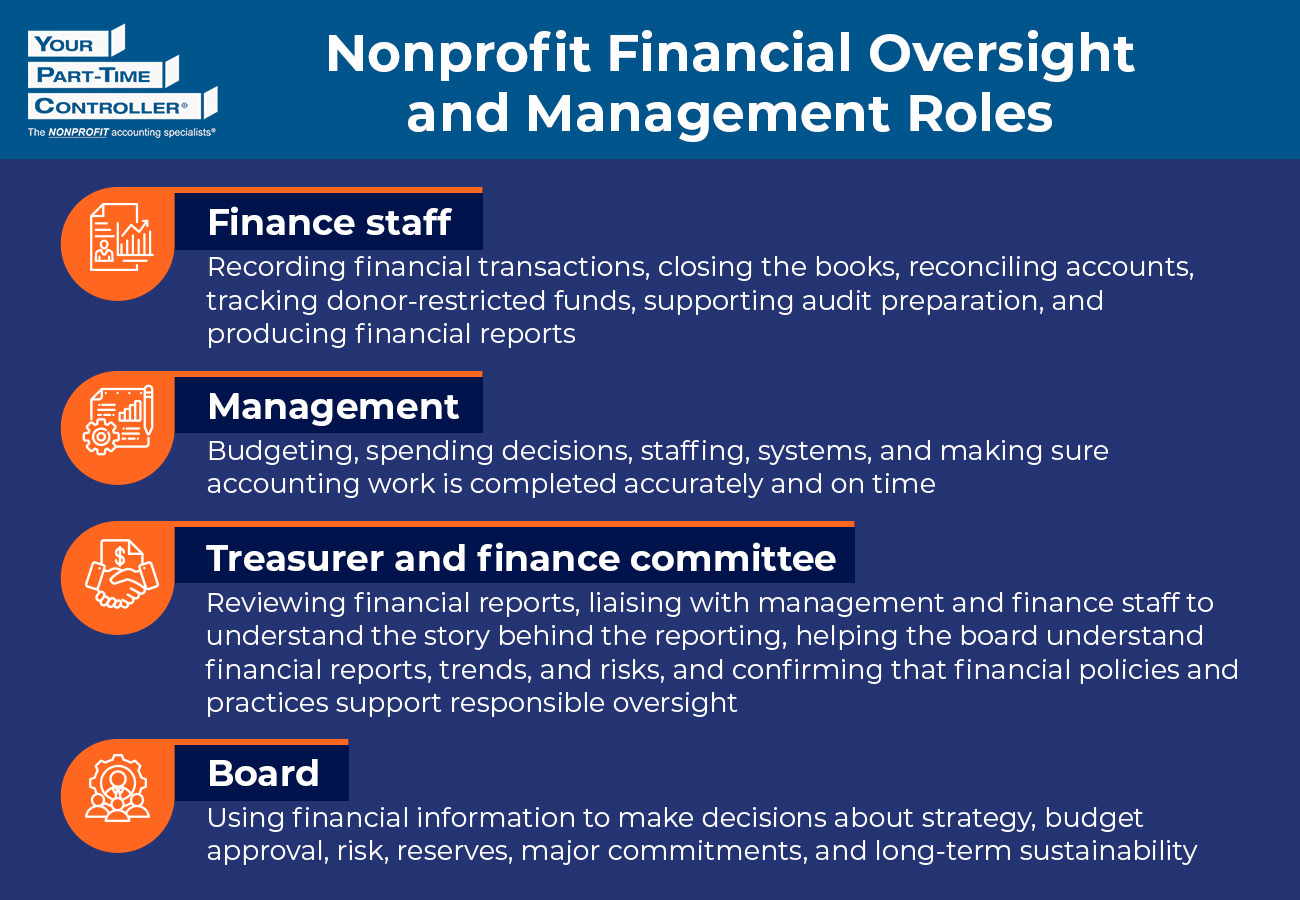
- Finance staff (accountants or bookkeepers) are responsible for recording financial transactions, closing the books, reconciling accounts, tracking donor-restricted funds, supporting audit preparation, and producing financial reports.
- Management (CFO or controller) is responsible for financial operations, including budgeting, spending decisions, staffing, systems, and making sure accounting work is completed accurately and on time.
- The treasurer and finance committee review financial reports at a governance level; liaise with management and finance staff to understand the story behind the reporting; help the board understand financial reports, trends, and risks; and confirm that financial policies and practices support responsible oversight.
- The full board uses financial information to make decisions about strategy, budget approval, risk, reserves, major commitments, and long-term sustainability.
In small nonprofits, the treasurer may be more hands-on with accounting operations. However, separation of certain responsibilities is critical: approval, access to funds, recordkeeping, and review. Even when optimal separation of duties is not possible, the board can usually add some layer of review, such as board review of bank statements, dual approval for payments above a threshold, documented reimbursement procedures, or periodic review by an outside accountant.
Separation of duties protects the organization and the treasurer and supports strong financial oversight and management.
Qualities of a Successful Nonprofit Treasurer
A strong nonprofit treasurer should bring integrity, financial expertise, leadership, communication, and critical thinking skills. The best treasurers translate numbers into plain language and guide the board toward sound financial decisions.
Let’s explore each of these qualities in greater depth:
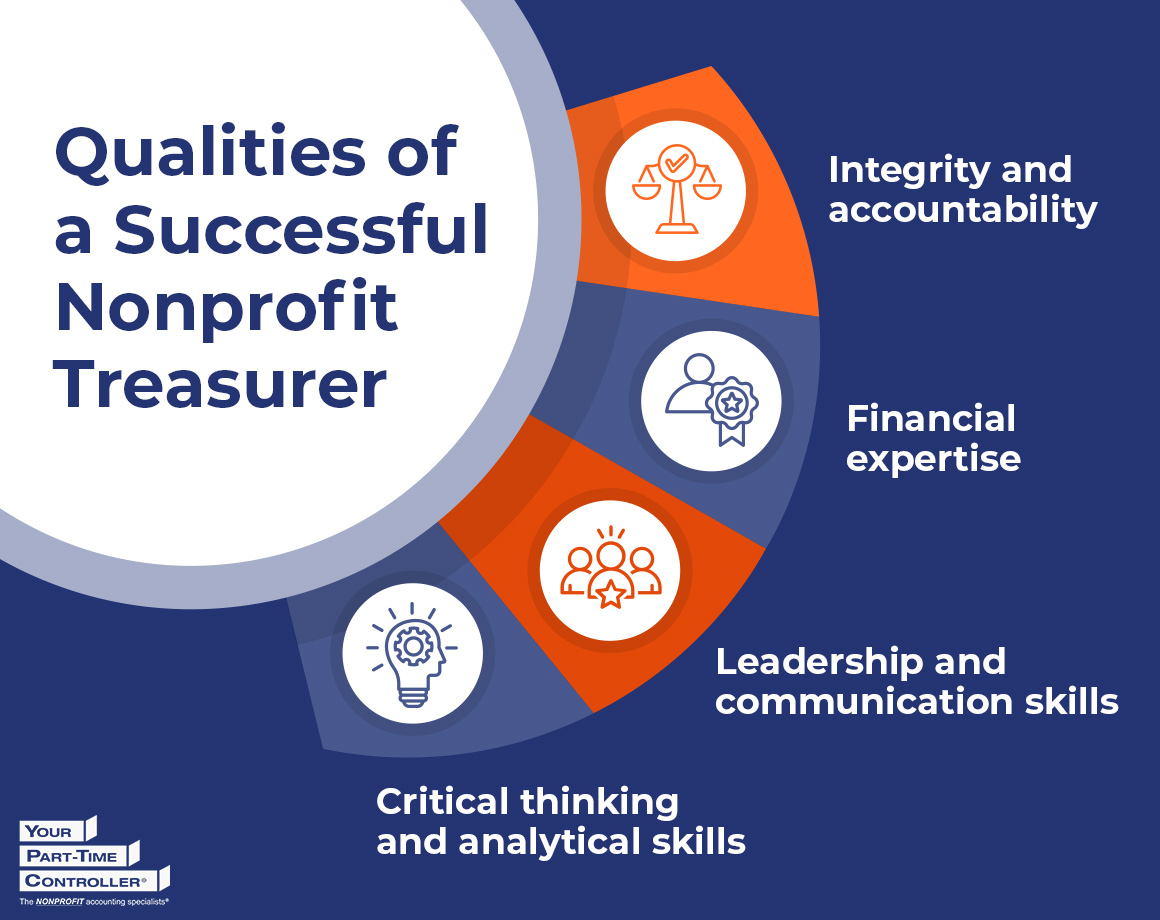
Integrity and accountability
Nonprofit treasurers have access to sensitive financial and strategic information, so strong ethics and trustworthiness are essential for this role. They need to take data security seriously and uphold your organization’s best interest.
Treasurers also need to have a thorough grasp of the finance calendar and a sense of personal accountability for ensuring that all applicable reporting, audit, and compliance deadlines are met and donor-imposed restrictions are followed.
Financial expertise
The treasurer should have a background in accounting, auditing, or finance and understand how core principles apply to nonprofits. They should be able to review and interpret nonprofit financial statements, budgets, and cash forecasts, restricted funds reporting, and internal controls. While they may not know every technical answer, they should know when an issue or question requires outside expertise or support.
Leadership and communication skills
Many board members do not have accounting backgrounds, so a nonprofit treasurer should be able to provide financial updates and present financial information in plain language, including important context and explanations. The treasurer works with the board chair, committee members, executive director, finance staff, outside accountants, and auditors. The role requires support, trust, communication, and respect for others’ responsibilities.
Critical thinking and analytical skills
A nonprofit treasurer should be able to spot financial trends, risks, and opportunities and ask follow-up questions, such as:
- Is a large receivable collectible?
- Are grant reimbursements delayed?
- Is there enough unrestricted cash to cover the next few months of operating costs?
- Are cash flows sufficient to support new programs or initiatives?
- Do fundraising strategies align with budgets and forecasted needs?
- Does a new grant or revenue stream add compliance risks?
The treasurer should understand how financial decisions affect programs, staffing, risk, and long-term sustainability.
Nonprofit Treasurer Duties FAQs
What is the difference between a treasurer, a CFO/controller, an accountant, and a bookkeeper?
Nonprofit finance roles can overlap, especially in small or quickly growing organizations, creating confusion and risk. For a growing organization, a clearer structure defines each role around its primary focus.
| Role | Primary focus | Typical responsibilities |
|---|---|---|
| Treasurer | Governance and board financial oversight | Helps the board understand financial information, trends, risks, and opportunities; monitor policies; and ask informed questions. Is often the financial liaison between management and the board. |
| CFO or Controller | Financial leadership and strategy | Provides executive- or senior-level financial leadership, strategic financial guidance, and planning. Oversees accounting work, including budgeting, reporting, and cash forecasting. |
| Accountant | Accurate records, reporting, and analysis | Prepares financial statements and reconciliations; supports budgeting, fund accounting, grant reporting, audit preparation, and other accounting processes, depending on the staffing model. |
| Bookkeeper | Transaction processing and recordkeeping | Records financial transactions; processes bills, deposits, and payroll; and maintains basic financial records. |
Each role has a distinct focus with clear responsibilities, and each supports the others as part of a strong finance function and governance model.
Are nonprofit treasurers paid?
Most nonprofit treasurers serve as unpaid board members, but practices can vary based on the organization’s bylaws, state law, policies, and structure.
If your organization is considering treasurer compensation, consult with your legal counsel and confirm that compensation is permitted under your bylaws, conflict-of-interest policy, funder requirements, and applicable state law. Make sure your arrangement is reviewed and approved through an appropriate, well-documented process.
Nonprofit treasurer compensation may also need to be reported on IRS Form 990. Work with your tax adviser to understand the IRS requirements that apply to your circumstances.
How long is a nonprofit treasurer appointed for?
A nonprofit treasurer’s appointment period should be set by the organization’s bylaws or board policies. Just like compensation arrangements, appointment terms can vary by organization and may be affected by state law. In many organizations, officer terms are one or two years and may be renewable, while board member terms are often longer and may be subject to term limits.
As a practical approach, consider aligning the treasurer’s term with your board leadership and succession planning needs. For example, a one-year renewable officer term might give the board flexibility, while a two-year term might provide more continuity for budgeting, audit oversight, Form 990 review, and finance committee leadership. Whatever approach you choose, the board should also revisit treasurer terms periodically.
What is the time commitment for serving as a nonprofit treasurer?
A treasurer’s time commitment depends on the organization’s size and complexity, the strength of its accounting support, whether the treasurer is chairing or participating on a finance committee, and whether the treasurer is serving only in a governance role or also filling operational gaps. For a governance-only role, the treasurer may spend several hours a month reviewing financial reports, meeting with management, preparing for and attending finance committee and full board meetings, and following up on questions.
A treasurer’s work often increases during budget season, audit preparation, and Form 990 reviews. Leadership transitions and major financial issues or discussions can also require additional time and attention.
If a treasurer’s role extends beyond governance, it requires more time. While this arrangement may be necessary for a very small organization or a limited time, the board should consider the risks, as well as options for capacity-building.
Should a nonprofit treasurer be a CPA?
Although accounting expertise is valuable, a nonprofit treasurer does not always need to be a CPA. A strong treasurer should understand your nonprofit’s funding model and be able to read and interpret financial statements, ask thoughtful questions, and understand financial risks.
They should also be able to communicate effectively with non-financial board members, as well as management, finance staff, external auditors, and outsourced accountants, when applicable. Experience with nonprofit finance, restricted funds, grants, internal controls, budgets, or other financial leadership can be helpful.
If your treasurer does not have this level of experience, your organization may benefit from outsourced nonprofit accounting support, such as board financial training, reporting improvements, or specialized guidance for technical issues.
When a Nonprofit May Need More Than a Treasurer
A strong nonprofit treasurer cannot make up for an underbuilt finance function.
In periods of growth, it’s common for nonprofits to add grants, staff, programs, locations, or compliance requirements that significantly increase the volume and complexity of accounting work without building the capacity to handle it. The treasurer may start filling gaps because they care about the mission and understand the numbers, but, over time, reliance on that volunteer effort increases risk for the organization and can overburden the treasurer.
Your nonprofit may need additional accounting or financial leadership support if:
- Audit preparation is stressful, or audit findings recur every year.
- You struggle to meet regulatory compliance deadlines.
- Financial reports are often late or hard to understand.
- Grant or restricted-fund tracking is inconsistent or insufficient.
- You aren’t forecasting cash or cash-flow surprises keep happening.
- The treasurer is doing hands-on accounting work by default.
- One person controls too many parts of the financial process.
- The organization is growing, adding programs, or managing more complex funding.
In these cases, outsourced accounting support or fractional CFO services can help you transform your accounting processes and reporting, so you can have smoother, more efficient audits, meet compliance deadlines, and generate better information for board and leadership decision-making.
Additional Nonprofit Governance Resources
The treasurer’s role in a nonprofit is one part of a larger financial governance system. When the role is clearly defined, the board can focus on oversight, management can focus on execution, and the finance function can produce information that leaders and boards need to make sound decisions.
YPTC works with nonprofit leaders, boards, and finance committees to strengthen financial reporting, budgeting, internal controls, audit readiness, Form 990 review processes, and cash-flow visibility. Contact us today so we can discuss a custom solution for your team.
If your organization is clarifying the treasurer role, improving financial policies and procedures, or deciding whether your current accounting support still fits your needs, these resources may help:
- Financial Governance for Nonprofit Boards: A Practical Framework. Learn how to strengthen your nonprofit’s financial governance as a whole in this guide.
- Exploring Nonprofit Financial Management: The Ultimate Guide. Receive answers to your questions about nonprofit financial management, including who does what, important documents and policies, and our tips for better financial health.
- What Is a Fractional CFO? Your Nonprofit Questions Answered. Explore the role of a fractional CFO and whether your nonprofit could benefit from one.


Jennifer Alleva
Jennifer Alleva is the Chief Executive Officer at Your Part-Time Controller, LLC (YPTC), a leading provider of nonprofit accounting and financial management services, a Top 100 Firm, and #1 on Accounting Today’s list of Best Firms to Work For. Jennifer brings over three decades of expertise in accounting and leadership to her role as CEO of YPTC.
When Jennifer joined YPTC in 2003, the firm consisted of just over 10 staff members. Since then, she has helped develop YPTC into one of the fastest-growing accounting firms in the country.
Jennifer’s accomplishments include her tenure as an adjunct professor at the University of Pennsylvania Fels Institute, her frequent speaking engagements on nonprofit financial management issues, and her role as the founder of the Women in Nonprofit Leadership Conference in Philadelphia. In addition, from 2021-2024, she hosted the Mission Business Podcast, which spotlighted professionals and narratives from the nonprofit sector.